
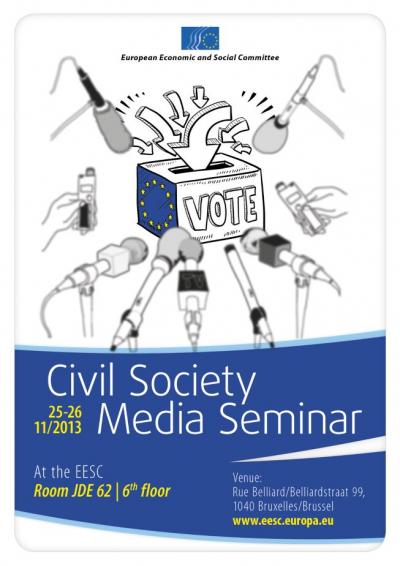
Addressed at communications experts and national and international media specialists, this year's EESC civil society media seminar focuses on effective ways of communicating the added value of the EU ahead of the 2014 European elections.
Communicating Europe's added value
For the seventh year in a row, the European Economic and Social Committee (EESC) is organising its civil society media seminar for communications experts and national and international media specialists. It will focus on effective ways of communicating the added value of the EU.
The seminar will be divided into four parts:
- branding and European image-building,
- communicating the cost of non-Europe,
- impact of new media on public communications,
- and the 2014 European elections' communications challenges.
In the first part, speakers will try to assess the usefulness of corporate brand strategies for the EU and stimulate a discussion between corporate strategists and those who say that Europe cannot be compared to a product as it lacks the clarity and impact of a corporate brand. Proponents of the view that the image of an organisation or political construction should be built on what it actually "delivers" will also have their say in this discussion.
The second part, focusing on ways of communicating the cost of non-Europe, will look into the benefits and drawbacks of communicating this storyline as compared to more traditional communications focused on success stories. Since communicating the cost of non-Europe seems to be, at least partly, about putting a positive spin on what may seem to be a negative message, the discussion panel will look at best practices from crisis communications.
The third part of the seminar will examine the impact of the changing media landscape on public communication. Although this new landscape, which is characterised by a plethora of channels and platforms, the growing importance of citizen journalism and a staggering amount of content, is fascinating, it is also challenging, not least for public communicators. Various approaches to this new environment will be discussed.
Given that the European elections, due in May 2014, are fast approaching, the fourth part of the conference will look at the effectiveness of various electoral communications strategies aimed at increasing voter turnout and engaging with voters. Speakers and participants will address questions on running the best EU-wide communications campaign, responding to voter prejudices about the EU and framing messages for maximum impact.
The seminar is being organised in cooperation with the European Parliament.