
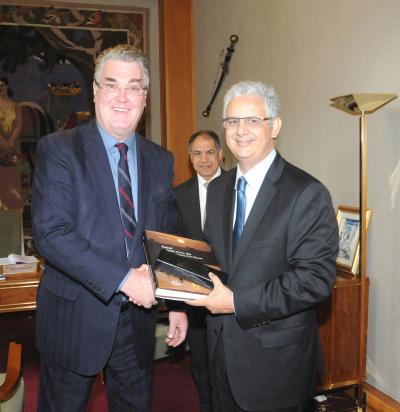
On 27 May, a delegation from the Moroccan ESEC, headed by its recently elected president Nizar Barak, visited the French ESEC to review cooperation between the two councils, established by a protocol signed on 27 September 2011 and already very active. The pace of implementation has been very satisfactory, particularly in terms of training. In practice, this has meant the arrival of six Moroccan trainees at the end of 2013 - four in the Administration and Budget Directorate, and two in the Communications Directorate - as well as the exchange of experiences. For example, ESEC vice-president Françoise Frisch attended a seminar on "New employability challenges in Morocco" at Rabat on 17 May 2012. In addition, Women's Rights delegation chair Geneviève Bel paid an official visit to the Moroccan ESEC from 23 to 29 June 2013, the Family Associations Union Group was visited by the Moroccan ESEC on 16 and 17 September 2013, and a delegation from the Moroccan ESEC attended a meeting in Paris on monitoring finances on 19 September 2013. ESEC president Jean-Paul Delevoye responded in person to an official invitation by his counterpart on 4 and 5 October 2012.
The Moroccan ESEC holds the first vice-presidency of UCESIF, the Union des Conseils Economiques et Sociaux et Institutions des Etats et gouvernements membres de la Francophonie (Union of Economic and Social Councils and Similar Institutions of French-Speaking Countries), and is currently working very closely with Michel Doucin, UCESIF secretary-general and diplomatic advisor to the French ESEC, on preparing a seminar to discuss implementation of social protection floors, to be held in Niamey on 19 and 20 September. Franco-Moroccan cooperation has also led to Euro-Mediterranean exchanges, particularly by means of the TransMed programme to promote exchanges between economic and social councils from both sides of the Mediterranean with a view to consolidating social and civic democracy.
During its visit the Moroccan delegation, whose members included Mr Nizar Baraka, Mr Driss Guerraoui, Ms Karima Mkika, Mr Jilali Hazim, Mr Aguizoul Tarek, Mr Mohamed Boulahcen and Mr Brahim Zidouh, attended a meeting of ESEC group chairs. After these discussions, it was agreed to continue and enrich this mutually beneficial cooperation, based on four priority themes: complementarity between ESCs and parliaments; decentralisation; the impact of demographic ageing on our societies (including migrants); and corporate social responsibility. A joint seminar on the latter subject could be held in Rabat in 2015.