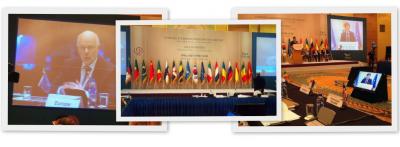
The International Association of Economic and Social Councils and Similar Institutions (AICESIS) Board meeting took place in Seoul. The EESC was represented by president Staffan Nilsson. The Korean Prime Minister welcomed the AICESIS Board along with representatives from Federation of Korean Trade Unions and Korea Employers Federation.
It was mentioned that the input from social partners and civil society is highly appreciated by the Korean government, and the Korean Economic and Social Development Commission is an important actor in this process. The Korean economy is relatively strong and unemployment rate is low. Free trade agreements with US and EU are welcomed by a majority. Some people and civil society organisations are still hesitating about opening up markets, and the civil society monitoring mechanism is crucial to follow the process and give stakeholders a chance to react.
The AICESIS is about networking of civil society actors from around the world, allowing them to meet, exchange practices and benchmark. This task has become more difficult and more important than ever in time of crisis. In many countries the setting up and developing of an economic and social council has gone hand in hand with the development and deepening of democracy. With all the differences in terms of structure, outputs and impact of their work, for all economic and social councils it is the process in which the society and civil society organisations are invited to debate and influence which is important. When stakeholders are engaged, the society "transition costs" are lower, because implantation is easily done after consultation.
President Staffan NILSSON stressed the important role the AICESIS could play in the exchange of good practises. On a European level he mentioned the Civil Society Contact Group (requested by the European Commission) as well as the network of national ESCs (very much appreciated by the Europen Commission). Furthermore he evoked the EESC’s participation in the Joint Monitoring Body set up to in the context of the EU-Korea FTA.