The Prime Minister received Patrick Bernasconi, President of the Economic, Social and Environmental Council and a delegation from the CESE office. The meeting provided an opportunity to take stock of the CESE's activities since its arrival at the head of the Council and in particular on the nine referrals sent by the Government to the CESE since early 2016.
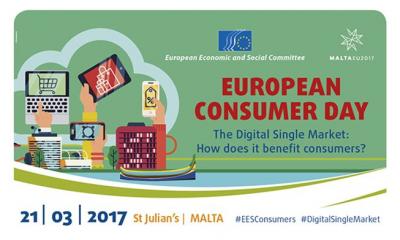
The Digital Single Market: How does it benefit consumers?
Today's digital transformation is reshaping our lives and our economies, generating profound changes in the way we produce, consume and access to services. But equally importantly, Europe needs a fully operational Digital Single Market to ensure that all European citizens can benefit from the advantages of the digital era safely and on an equal footing.
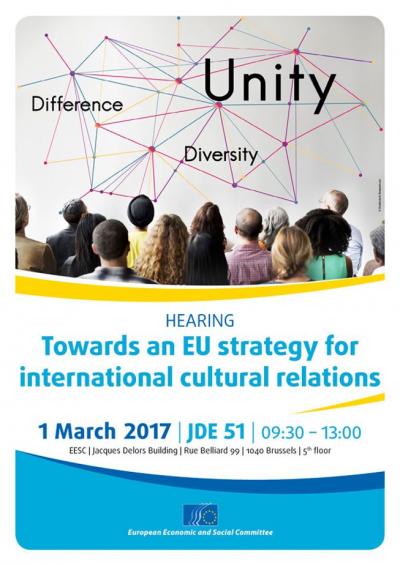
On June 2016, the Commission and the European external Action service presented the Joint Communication 'Towards an EU strategy for international cultural relations'. In it, three work streams are outlined:
Supporting culture as an engine for sustainable social and economic development. It involves supporting the development of cultural policies in other countries and strengthening cultural and creative industries, recognizing their economic weight and their potential for creating smart sustainable jobs.
Promoting Culture and intercultural dialogue for peaceful inter-community relations. It encompasses cooperation amongst cultural operators and fostering peace-building through Inter-Cultural Dialogue.
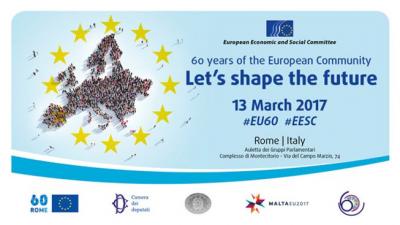
In the framework of the celebrations for the 60th anniversary of the Rome Treaties, the European Economic and Social Committee held a high-level conference in Rome on 13 March 2017, entitled Sixty years of the European community — Let's shape the future. The EESC decided to focus on the important milestones achieved by the European project and, above all, explored three issues crucial to overcome the current crisis and guarantee a better future for Europe: tackling growing social inequalities, getting back on track for economic growth and providing an effective response, consistent with the principles of the European Union, to the challenge of migration.
The European Migration Forum – the civil society dialogue platform on migration, asylum and migrant integration – will meet for the third time on 2nd and 3rd of March 2017 at the EESC's headquarters.
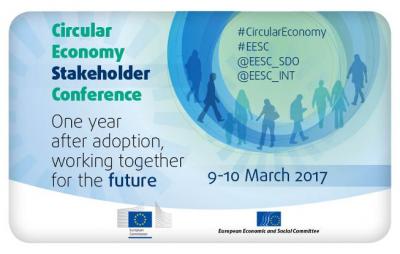
A more sustainable European economy implies reducing drastically our consumption of resources and the amount of waste we produce. Far from being an exclusively environmental concern, the transition to a circular, more resource-efficient economy is a business and social opportunity, leading to new markets and new jobs.
As part of the celebrations for the 60th anniversary of the Rome Treaties, the EESC, together with the Italian Council of Ministers and under the patronage of the Italian Parliament, is organising a conference on Sixty years of the European community — Let's shape the future, on 13 March 2017 at the Chamber of Deputies in Rome.
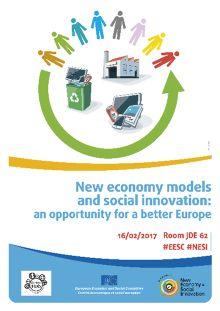
In the last couple of years, the combination of opportunities brought about by the digital revolution and the emergence of new consumer behaviours and aspirations have triggered radical change in the way we buy, exchange or even value goods and services, also known new economy models.Their impact on businesses, consumers and workers is considerable. As the European voice of civil society, we have recognised both the potential of these new models for Europe's sustainability as well as the uncharted legal territory they bring with them. In 2016, we published opinions on the circular economy, the functional economy and the collaborative economy, proposing innovative solutions to complex issues thrown up by so-called disruptors.
First of all, I wish you a happy New Year full of success and peace!
The Presidency of the Council of the European Union starting in January 2017 will be the first time for the Republic of Malta. For that reason the European Economic and Social Committee Plenary Session will feature a presentation on the priorities of the Maltese Presidency on 25 January by Dr Ian Borg, Parliamentary Secretary for the EU Presidency 2017 and EU Funds. At a time when European Union cohesion is being put to the test it falls to Malta to play an important part in contributing to unity rather than dividing or making unilateral decisions. I am convinced that Malta is capable of successfully ushering in a new era for Europe. I am particularly pleased to see that the Maltese Presidency priorities include proposals made by our Committee.
Grassroots mobilisation and the recent media coverage of certain scandals in France and worldwide (such as Luxleaks, Panama papers, Bahama leaks and Football leaks to mention but a few) have brought to light the sheer scope of tax avoidance mechanisms and their impact on the funding of public services. The European Commission puts the loss of tax revenue every year at more than €1,000 billion. In France, these estimations are in the range of €60 to 80 billion.