Plenary Session - Charlemagne Building (European Commission), Room S3, 1040 Brussels, Belgium
09/07/2014 > 10/07/2014
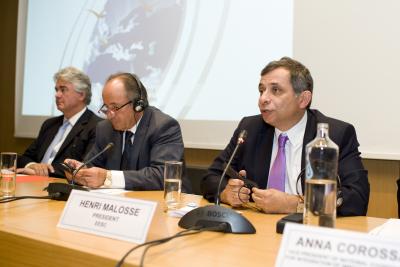
500th plenary session with the participation of the following guests: Sandro Gozi, Italian Secretary of State for European Affairs, Peter Bofinger, member of the German Council of Economic Experts, Edmond Alphandéry, Chairman of the Board of Directors of the Centre for European Policy Studies (CEPS) and former French Minister for Economic Affairs, and a representative of the European Central Bank, Kyriakos Gerontopoulos, Deputy Minister of Foreign Affairs of the Hellenic Republic
In the framework of the Greek Presidency of the Council of the European Union, the Economic and Social Council of Greece hosted an International Conference entitled "A comprehensive and common migration policy in Europe: What are the challenges for cooperation with third countries?". The event was held at the Acropolis Museum in Athens, on Monday, June 30, 2014.
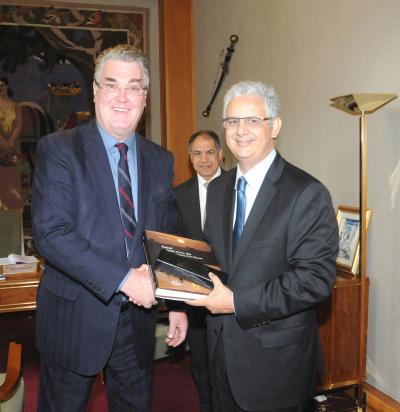
On 27 May, a delegation from the Moroccan ESEC, headed by its recently elected president Nizar Barak, visited the French ESEC to review cooperation between the two councils, established by a protocol signed on 27 September 2011 .
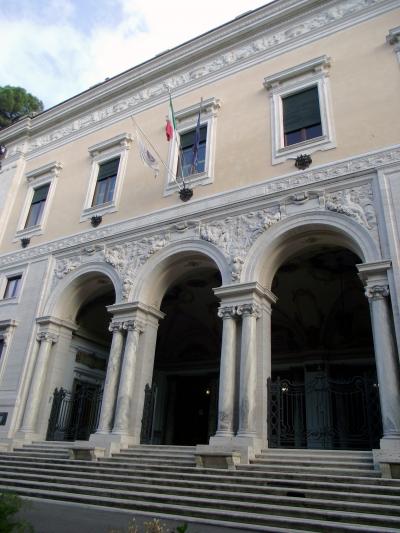
The EESC Workers' Group will hold an extraordinary meeting at the premises of the CNEL (Consiglio Nazionale Economia e Lavoro - Italian National Council for Economics and Labour) in Rome on 26 September 2014.
Chaired by group president, Georgios Dassis, the event will unveil the priorities of the Italian Presidency of the European Union and examine the economic and social situation in Italy.
During the conference a study will be presented on "the representation of the labour world in national and European institutions" carried out by the University of Verona.
The European Union is undergoing a profound crisis of legitimacy. While two thirds of Europeans living in the euro area still support the common currency and economic and monetary union, only a third say they have faith in the EU's institutions, which is the lowest level ever recorded. Moreover, a growing majority believe that their voice is not heard loudly enough.
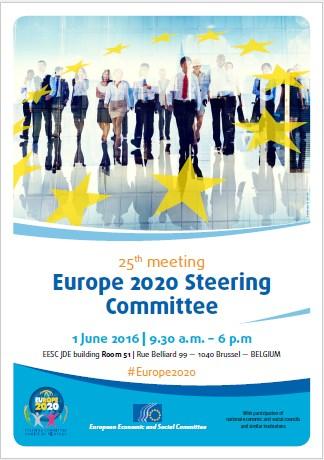
The Europe 2020 Steering Committee's 25th meeting is to be held at the EESC building, Brussels, on 01 June 2016, from 2.30 p.m. until 6 p.m., in room JDE-51.
The Spanish ESC analyses the economic situation in the EU, and problems of institutional confidence
• The EU should take a less restrictive approach in fiscal policy, albeit without questioning the need for fiscal consolidation, so as to substantially boost public investment. The Council also considers that greater flexibility should be allowed in complying with the consolidation roadmap.
• The European Fund for Strategic Investments, fleshing out the Juncker revival plan, appears unsuitable for giving fiscal impetus to the regions where the crisis is most severe and which have less budgetary margin for backing investment projects.
• The Council believes it would be reasonable to strengthen the EU budget and to establish mechanisms for mutualising public debt, but no progress has been made in this field.
• Regarding national competitiveness boards, which are to have a mandate to assess whether wages are evolving in line with productivity, the Council expresses concern that this power may clash with the model on which wages are determined in the Spanish institutional framework.
• The Council sees a need for greater coordination and convergence in the field of economic and social policy in order to reduce the great disparities in competitiveness and social cohesion.
• The EU’s new economic governance has had the effect of reducing the role of trade unions and employers’ organisations at European level in the decision-making process.
• Community governance has proved deficient in taking decisions in a joint and operative way in response to the challenges arising. The EU faces three crises: Community governance, asylum and refuge, questioning Europe’s traditional values and culture of hospitality and even the principle of free movement, and a neighbourhood crisis, demonstrating the weakness of European foreign policy. Europe continues to work on an intergovernmental logic that has generated a loss of legitimacy in EU institutions, resulting in disaffection in the general public.
• An EU political and institutional political architecture is needed to ensure that the transfer of national sovereignty to the Union is accompanied by greater democratic legitimacy and accountability of EU institutions.
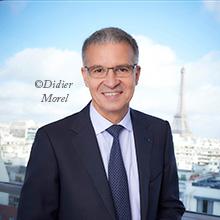
Mr. Patrick Bernasconi was elected President of the French ESEC, Tuesday 1st of December 2015. In the first round of ballot, he received 131 votes, before Jean-Paul Delevoye (63 votes) and Gérard Aschieri (30 votes). The former Council’ President, Jean-Paul Delevoye, resigned from his position as adviser.